

Enduro vs Downhill: Two Very Different Sports (Or Are They?)

Downhill Vs Enduro
Mountain biking encompasses various sub-disciplines, each presenting unique physiological, biomechanical, and psychological demands. Among these, Enduro and Downhill (DH) racing stand out as two of the most physically and cognitively challenging formats. While both are categorised as gravity-based disciplines, their differences in race duration, structure, and intensity lead to distinct performance profiles. This paper critically examines the contrasting demands of Enduro and Downhill MTB, focusing on energy system utilisation, neuromuscular characteristics, training specificity, injury risk, psychological stressors, and athlete monitoring strategies. By synthesising current literature and applying principles of applied sport science, the aim is to demonstrate how adequate preparation for each discipline must be distinct, data-informed, and context-specific.
Enduro racing typically spans five or more hours and consists of multiple timed downhill stages interspersed with untimed transition segments, often performed at lower intensities. These transitions require aerobic output, while the timed stages demand high-intensity bursts of power and technical execution. The dual demand on both aerobic and anaerobic energy systems positions Enduro as a hybrid endurance and power sport. In contrast, Downhill competition is characterised by short-duration, maximal-intensity efforts ranging from two to five minutes, placing a premium on anaerobic capacity, explosive power, and neuromuscular coordination. The structure of Downhill racing necessitates the production of maximal force, rapid technical decision-making, and precise execution under high psychological pressure (Zemková, 2014).
Physiological distinctions between the two disciplines are marked by their energy system profiles. Enduro athletes rely heavily on aerobic metabolism for the prolonged duration of competition, particularly during transitions and between-stage recovery periods. High maximal oxygen uptake (VO₂ max) is strongly associated with enhanced work capacity and improved fatigue resistance, especially during multistage events where consistent output is required over several hours (Hausswirth & Le Meur, 2011). Training for Enduro thus emphasises the development of aerobic efficiency through sub-threshold intervals, tempo sessions, and long steady-state rides. Additionally, repeated anaerobic demands within stages necessitate lactate tolerance and the capacity to recover between efforts.
Conversely, Downhill performance is primarily underpinned by anaerobic energy systems, with emphasis on the phosphocreatine and glycolytic pathways. These allow for rapid energy mobilisation to support explosive movements and high-intensity efforts required for technical terrain negotiation, aggressive cornering, and frequent accelerations. The reliance on anaerobic systems is coupled with a need for maximal rate of force development (RFD), neuromuscular synchronisation, and acute fatigue resistance (Suchomel et al., 2016). Conditioning programmes therefore focus on sprint intervals, plyometrics, and explosive strength exercises aimed at enhancing short-term power output and technical control.
From a neuromuscular perspective, the mechanical loading demands between disciplines also diverge significantly. In Enduro, cumulative fatigue across long competition days necessitates muscular endurance and isometric strength, particularly in the upper body and core. The repetitive demand for trunk stabilisation, upper limb support, and grip strength during extended descents leads to progressive fatigue, particularly in the posterior chain and forearms (Granier et al., 2018). Resistance training for Enduro athletes often targets these regions using protocols that emphasise time-under-tension, anti-rotational stability, and isometric endurance. Grip-intensive tasks, loaded carries, and unilateral core training are frequently integrated to address specific performance limiters.
In contrast, Downhill riders encounter acute, high-impact mechanical stresses resulting from rapid deceleration, landings, and braking. Eccentric strength is a critical determinant of performance, as it facilitates joint control, injury prevention, and dynamic force absorption (LaStayo et al., 2003). Plyometric training, eccentric overload exercises (such as Nordic hamstring curls), and high-velocity strength work are key components of Downhill strength and conditioning. The objective is to develop the ability to produce and absorb force rapidly, ensuring stability and control during sudden terrain changes and impacts. Although both groups benefit from core stiffness and energy transfer through the kinetic chain, the nature and timing of neuromuscular activation differ substantially (McGill et al., 2014).
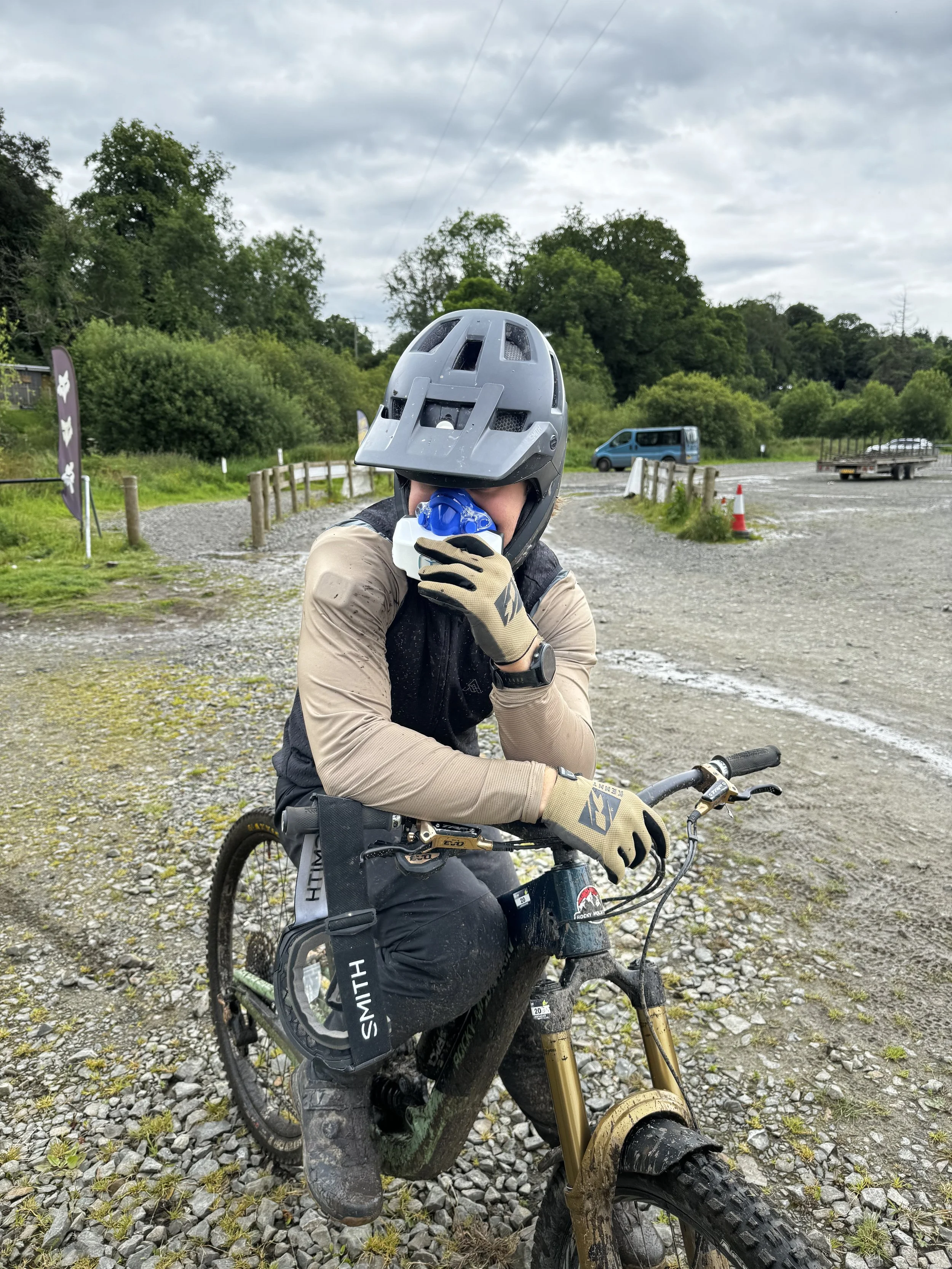
Remi - Rocky Mountain EDR Rider 2024 Field Testing
Training specificity must mirror the demands of each discipline to optimise adaptations. For Enduro athletes, periodised programmes often include aerobic conditioning sessions, muscular endurance circuits, and high-intensity interval training (HIIT). In the gym, resistance sessions typically use moderate loads and higher volumes, structured through formats such as Every Minute on the Minute (EMOM) or As Many Rounds As Possible (AMRAP) to mimic prolonged muscular demand. Exercises often include Romanian deadlifts, pull-ups, kettlebell swings, and carries, designed to improve muscular resilience and metabolic conditioning.
By contrast, Downhill training programmes prioritise neural freshness and high output. Weekly structure often involves fewer sessions, with a focus on maximal intent and power development. This may include velocity-based resistance training (VBT), contrast sets (pairing heavy lifts with plyometric movements), and brief but intense anaerobic intervals on equipment like the Assault bike or rowing ergometer. Due to the high neural load of such training, recovery modalities—including soft tissue therapy, HRV tracking, and sleep hygiene—are emphasised to maintain performance readiness and reduce injury risk.
Injury profiles also reflect the different mechanical and physiological demands of each discipline. Enduro athletes often experience overuse injuries, particularly affecting the lower back, shoulders, and wrists, due to cumulative load and fatigue. Strategic deload weeks, mobility protocols (e.g., hip openers, thoracic rotation drills), and prehabilitation routines are essential for reducing chronic strain. Downhill athletes, in contrast, face higher rates of acute traumatic injury, including shoulder dislocations, acromioclavicular (AC) joint sprains, and concussion. In this context, strength and conditioning serve a protective role by developing joint integrity, proprioception, and force attenuation capacity (Ferguson et al., 2021). Exercises such as landmine presses, external rotations, and impact-specific drills enhance musculoskeletal robustness and resilience under load.
Psychological demands, while often underemphasised in physical preparation programmes, are fundamental to performance outcomes. Enduro racing demands sustained concentration, adaptability, and the ability to regulate arousal over extended periods and varying stage intensities. Mental fatigue management becomes increasingly relevant as the day progresses, with the risk of cognitive lapses rising in tandem with physiological fatigue. Psychological skills such as mindfulness, self-talk, and focus cues are beneficial tools for maintaining engagement (Fletcher & Sarkar, 2012).
Downhill racing presents a contrasting psychological profile, dominated by acute arousal and pressure. With a single timed run, athletes must perform at their absolute limit with minimal margin for error. Psychological preparation strategies such as pre-performance routines, visualisation, and arousal modulation techniques (e.g., controlled breathing) are central to effective execution (Hanton et al., 2008). Integrating sport psychology into daily and weekly routines can enhance self-regulation and improve performance consistency under competitive stress.
Effective monitoring and athlete profiling strategies must also be discipline-specific. In Enduro, testing typically involves VO₂ max assessments, lactate threshold testing, and heart rate variability (HRV) monitoring to gauge recovery status and training adaptation. Emerging technologies, such as wearable muscle oxygenation monitors (e.g., near-infrared spectroscopy), provide non-invasive insights into local muscular fatigue and recovery capacity. Muscular endurance tests and movement screens can identify asymmetries or weaknesses that may affect long-term performance.
Downhill athlete profiling, by contrast, emphasises neuromuscular readiness and explosive performance. Common assessments include the countermovement jump (CMJ), isometric mid-thigh pull, and eccentric hamstring testing using tools such as the NordBord. These metrics provide insight into power output, force symmetry, and injury risk. Monitoring readiness to train through subjective wellness questionnaires and objective markers enables practitioners to adjust training loads in real time, supporting recovery and mitigating performance decrements.
Despite the apparent divergence in physical demands, one notable physiological crossover between disciplines is VO₂ max. While it is a primary determinant of endurance performance, a well-developed aerobic base also supports Downhill athletes by improving between-run recovery, thermoregulation, and general training capacity (Jones & Carter, 2000). Research has shown that endurance adaptations improve mitochondrial function, cardiac output, and fatigue resistance, all of which indirectly support anaerobic performance. Consequently, base phase programming in both disciplines often includes aerobic conditioning blocks aimed at elevating ceiling capacity, even if event-specific demands differ.
In conclusion, Enduro and Downhill MTB represent two highly specialised performance domains within the broader sport of mountain biking. Each discipline places unique demands on energy systems, neuromuscular function, and psychological resilience. As such, training interventions must be data-informed, context-specific, and reflect the true complexity of each event. Practitioners must resist generic programming approaches and instead adopt methodologies grounded in sport science, tailored to the athlete’s physiological and psychological profile. This level of precision not only enhances performance outcomes but also supports long-term athlete development and durability in high-risk, high-output environments.
References
Ferguson, C., Smith, T. B., Fairweather, M., & Reilly, T. (2021). Eccentric strength: A key factor for reducing injury risk in high-impact sports. Journal of Strength and Conditioning Research, 35(4), 1041–1050.
Fletcher, D., & Sarkar, M. (2012). A grounded theory of psychological resilience in Olympic champions. Psychology of Sport and Exercise, 13(5), 669–678.
Granier, C., Abbiss, C. R., Aubry, A., Vauchez, Y., & Hausswirth, C. (2018). Power output and physiological responses during mountain biking. Journal of Strength and Conditioning Research, 32(1), 13–25.
Hausswirth, C., & Le Meur, Y. (2011). Physiological and nutritional aspects of post-exercise recovery. Sports Medicine, 41(10), 861–882.
Hanton, S., Mellalieu, S. D., & Hall, R. (2008). Re-examining the competitive anxiety trait-state relationship. Personality and Individual Differences, 45(4), 328–338.
Jones, A. M., & Carter, H. (2000). The effect of endurance training on parameters of aerobic fitness. Sports Medicine, 29(6), 373–386.
LaStayo, P. C., Woolf, J. M., Lewek, M. D., Snyder-Mackler, L., & Lindstedt, S. L. (2003). When active muscles lengthen: Properties and consequences of eccentric contractions. Journal of Orthopaedic & Sports Physical Therapy, 33(10), 557–571.
McGill, S. M., Karpowicz, A., Fenwick, C. M., & Brown, S. H. (2014). Exercises for the torso performed in a standing posture: Spine and hip motion, motor patterns, and spine loading. Journal of Strength and Conditioning Research, 28(1), 183–189.
Suchomel, T. J., Nimphius, S., & Stone, M. H. (2016). The importance of muscular strength in athletic performance. Sports Medicine, 46(10), 1419–1449.
Zemková, E. (2014). Sport-specific assessment of the effectiveness of neuromuscular training in competitive athletes: A review. Sports Medicine, 44(7), 1025–1046.
