
The number of Elite Enduro athletes.
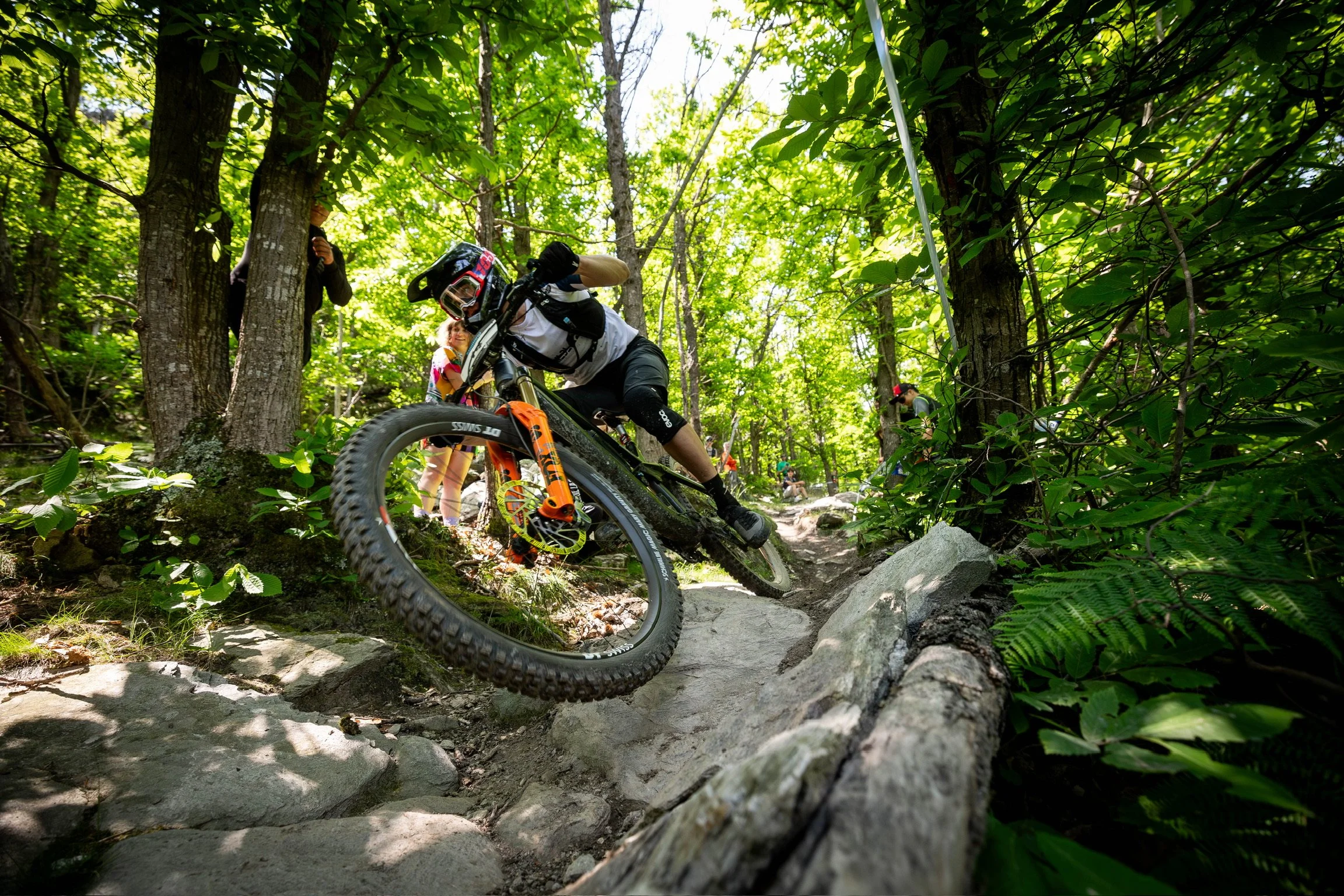
Men’s EDR Elite Rider Tarmo
The Lab
When it comes to Enduro racing it has long been recognised that these athletes are fit. But what does the elite physiology look like? Just how fit is the modern day enduro athlete?
We've gone looking for a proper answer. Some of what follows comes from published research on elite enduro racers. Some of it comes from our own season long research project, tracking the physiological profiles of ten UCI EDR World Cup elite athletes across the 2026 season. And because "fit" only means something in comparison to something else, we've lined the numbers up against elite road cycling too, arguably the most heavily researched endurance sport there is.
Why we test what we test
Fitness isn't one number. A rider's metabolism is really a system of trade offs between how much oxygen they can use, how quickly their muscles produce lactate, how big a reserve they have above their sustainable pace, and how efficiently they burn fat rather than carbohydrate. Our physiological testing, run through the Topp Cycling platform and built on the Mader and Heck model of energy metabolism, breaks this down into five numbers: VO2 max, Critical Power, W', the VLamax to VO2 max ratio, and Fatmax. Below is what those numbers actually look like in an elite enduro field, and where they sit next to elite road cycling.
The Ceiling: VO2 Max and Critical Power
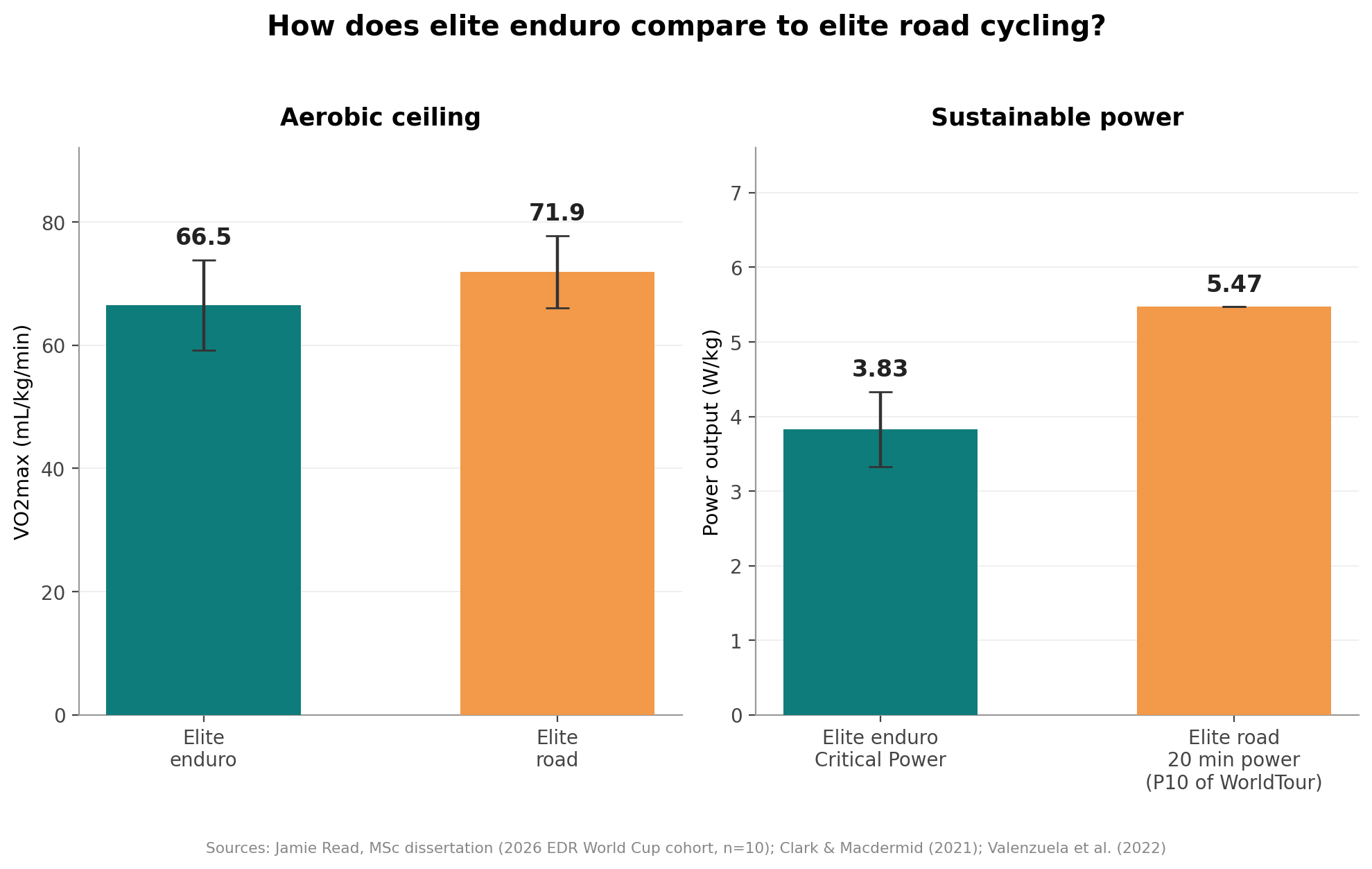
VO2 max is the size of the aerobic engine, the ceiling on how much oxygen a rider can use per minute. Across our ten athlete cohort over the 2026 season, average VO2 max sat at 66.5 mL/kg/min, ranging from 57.8 up to 77.5 at the top of the field. For context, elite road cyclists tested under controlled lab conditions have averaged 71.9 mL/kg/min (Clark & Macdermid, 2021). That's a genuinely small gap. The best enduro engines in our cohort would not look out of place in a road lab.
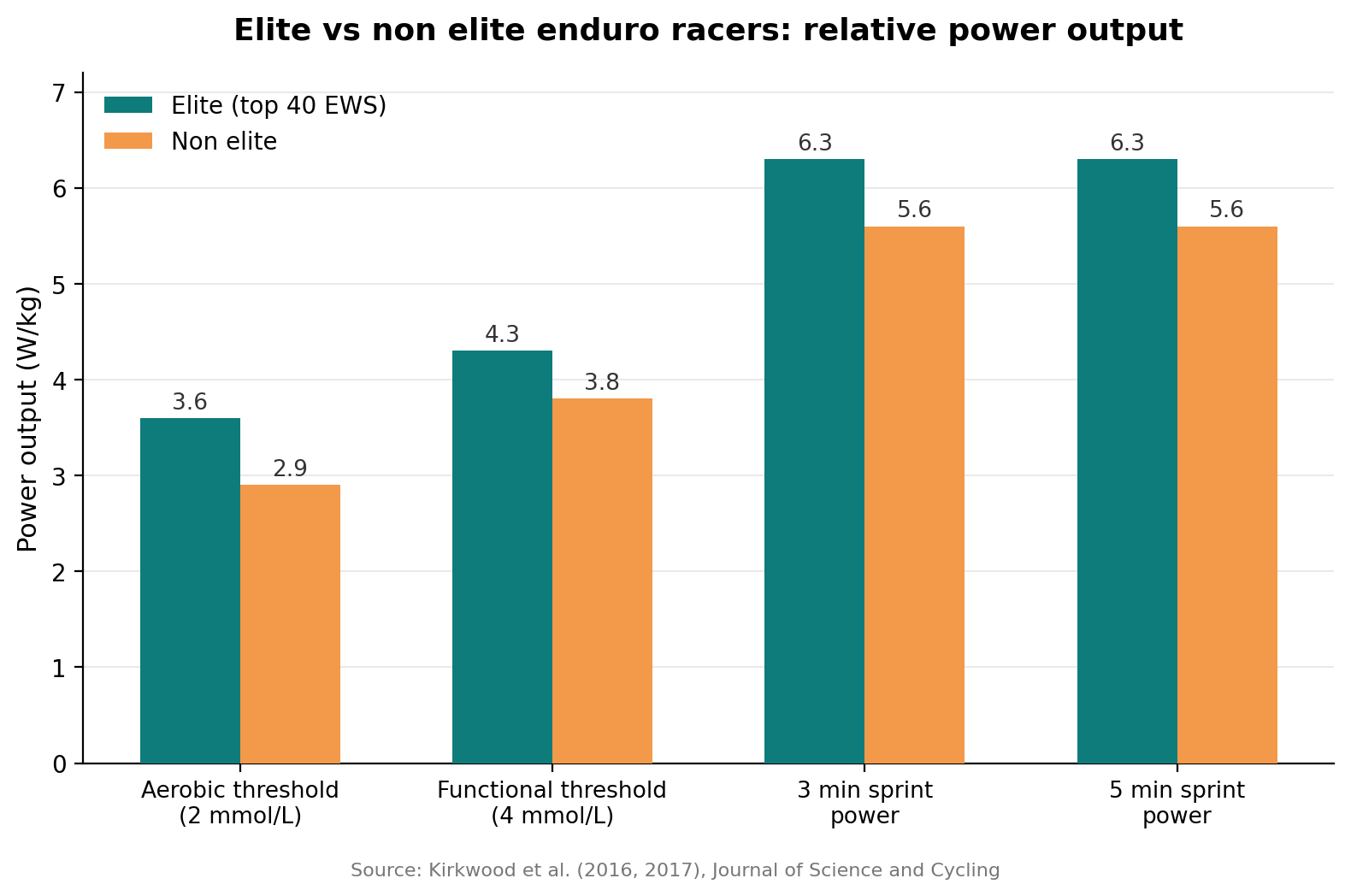
Critical Power tells a different story. This is the highest output a rider can sustain before fatigue becomes unavoidable, expressed relative to body mass. Our cohort averaged 3.83 W/kg, ranging from 3.32 to 4.67. Kirkwood et al. (2017), the only other published enduro specific dataset, found a comparable figure using functional (4 mmol/L) threshold power: 4.3 W/kg in elite riders. Elite road cyclists, by comparison, need to be far higher here. Even riders sitting at just the 10th percentile of the professional WorldTour peloton hold 5.47 W/kg for a 20 minute effort (Valenzuela et al., 2022); the top 10% exceed 6.5 W/kg.
Put those two numbers together and you get a genuinely interesting picture. Enduro athletes carry a road worthy aerobic ceiling, but they are not required to sustain road level output continuously, because the sport doesn't ask them to. What it asks for instead is repeated access to a big reserve above that ceiling, stage after stage.
The Reserve: W'
W' is that reserve: the finite amount of work a rider can do above Critical Power before they're forced to back off. Think of it as an anaerobic battery. Our cohort averaged 314 J/kg, with a wide spread from 132 to 399 J/kg, roughly comparable to the anaerobic capacity typically reported in trained and elite road cyclists.
This matches what Kirkwood found in the field: elite enduro riders didn't just produce more peak sprint power than non-elite riders, they held a higher average output across repeated 3 and 5 minute sprint efforts, 6.3 W/kg against 5.6 W/kg. A well stocked reserve is one thing. Spending it wisely, stage after technical stage, is another, and it's what appears to separate elite riders from the rest of the field.
Durability: the metric nobody was testing for
Here's where our own research adds something the published literature doesn't yet cover. We didn't just measure these numbers once, we tracked them against season long race performance across five World Cup rounds. VO2 max and Critical Power, the two "ceiling" numbers above, predicted overall season pace. They had no meaningful relationship with how much an athlete faded within a single round.
The opposite was true of the VLamax to VO2 max ratio, our cohort averaged 0.0103, ranging from 0.0089 to 0.0126, and of W'. These predicted fatigue resistance within a round and had little relationship with pace. In plain terms: how big your engine is decides how fast you can go, but how well balanced your glycolytic system is against that engine decides whether you can still access that speed on stage four of a long day.
Fuel Economy: Fatmax
The last piece is Fatmax, the power output at which a rider burns fat at the highest rate. Our cohort averaged 2.43 W/kg, ranging from 2.03 to 2.92. Enduro days aren't short: UCI EDR World Cup rounds run three to nine hours including transitions, so how efficiently a rider fuels the quieter parts of the day between race stages matters as much as what they can produce during them.
What this means in practice
We've started using a simple four axis framework to talk about this with athletes: Ceiling (VO2 max, Critical Power), Reserve (W'), Durability (the VLamax:VO2max ratio), and Fuel Economy (Fatmax). No single number tells the whole story, and our data suggests you genuinely cannot train just one of these and expect it to cover for the others. An athlete with a huge ceiling and a poor durability profile will be fast in round one and fading by stage three. An athlete with excellent durability and a modest ceiling will hang on well but never contend at the front.
So, just how fit does the modern enduro athlete need to be? Fit enough to sit within touching distance of a road professional's aerobic ceiling, while carrying and repeatedly spending an anaerobic reserve that road racing rarely demands. It's a different kind of fitness to road cycling, not a lesser one.
References
Clark, B., & Macdermid, P. W. (2021). A comparative analysis of critical power models in elite road cyclists. Current Research in Physiology, 4, 139–148.
Kirkwood, L., Ingram, L., Cunningham, J., Malone, E., & Florida-James, G. D. (2017). Physiological characteristics and performance in elite vs non-elite enduro mountain biking. Journal of Science and Cycling, 6(2), 13–21.
Mader, A., & Heck, H. (1986). A theory of the metabolic origin of "anaerobic threshold". International Journal of Sports Medicine, 7(S1), 45–65.
Read, J. (2026). Does metabolic efficiency predict race performance in enduro mountain biking, and is this relationship moderated by course demands? Unpublished MSc dissertation, University of Stirling.
Valenzuela, P. L., Muriel, X., van Erp, T., Mateo-March, M., Gandia-Soriano, A., Zabala, M., Lamberts, R. P., Lucia, A., Barranco-Gil, D., & Pallarés, J. G. (2022). The record power profile of male professional cyclists: Normative values obtained from a large database. International Journal of Sports Physiology and Performance, 17(5), 701–710.
